This BLOG serves the condo residents of our Village , WPB, FL. We attempt to provide accurate information but such information does not in any way constitute legal or professional advice. This Web Site is not censored, except in the case of extreme and offensive posts. As such, the posts are representative of the poster's opinion only. This BLOG cannot be held liable for actions arising from its use or for the contents of any externally linked pages.
First one I have seen in the village, though they are common in surrounding neighborhoods, and Frank Cerabino's pool. It is vegetarian, does not even eat midgies. Shy - swam away.
Racoons can be out in the daytime especially when they are hungry babies looking for loquats. Actually the village is so brightly lit all night none of our critters could be classed as nocturnal, maybe crepuscular. These are Sussex racoons, click photos to enlarge.
Palm Beach County Animal Care and Control's Captain David Walesky tells us there were only a total of 4 rabies cases in all of Palm Beach County in 2011. Therefore, there is no need to panic at the sight of racoons, just be normally cautious.
The young umm.. mallards are doing well. Who is the other guy, Google similar images did not produce?! .............................................................................
Egyptian Goose after proper roasting: (Propius Roasticus)
A challenge for our species expert. Billions of these are around the CV waterways just above water level. They stick on rocks and geotube. A clue – it’s on the ‘100 of the World's Worst Invasive Alien Species List’.
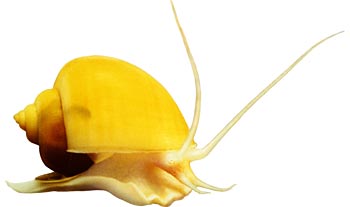
These are our brown CV apple snail shells. That bright yellow one crawled onto my post by itself, it does have its own website, http://www.applesnail.net/ Do you have your own website?!?
These extra pics and comments are tacked on days after first post ...
"The Indian Peafowl (Pavo cristatus), also called the Blue Peafowl or Common Peafowl, is native to India and Sri Lanka. It is the national bird of India. Because of its legendary beauty, it was domesticated more than 2000 years ago, and has since been exported to many other countries. The familiar bird with the beautiful display feathers is actually the male, or peacock—the female bird is called a peahen, and young are called peachicks.
Peafowl are classified with the pheasants in the taxonomic family Phasianidae, and are thus related to partridges, quail, chickens, and turkeys. There is one other peafowl species in the genus Pavo: Pavo muticus, the Green Peafowl.
Blue Peafowl Natural History and Habitat Facts
Peacocks and peahens can live for at least 15 years in captivity, but they probably do not live as long in the wild:
•The natural habitat of peafowl is dry open forest. The birds remain on the ground most of the time and do not fly long distances.
•In the wild, peafowl nest and feed on the ground, but roost high in the trees, ascending early in the evening.
•The eerie call of the peafowl is often heard when rain is approaching.
•The white peacock, seen more often in captivity, is a genetic mutation, rather than an albino bird.
•Peafowl tend not to get on well with other domestic animals.
•Although their natural ranges do not overlap, the Blue Peafowl and the Green Peafowl, native to Southeast Asia, can interbreed. The resulting hybrid bird is called a Spalding.
Blue Peafowl Feeding Facts
Domestic peafowl are valued in India because they eat young cobras, thus keeping the numbers of these venomous snakes down in human communities. The birds are relatively easy to feed:
•Peafowl eat insects, seeds, plant seedlings, fruit, and small reptiles.
•Because of their taste for seeds and insects, peacocks and peahens are drawn to gardens and compost piles, where they can become a nuisance.
Courtship and Breeding Facts
Peafowl will breed at about two years of age; however, the peacocks’ magnificent display feathers continue to grow until the birds are six years old. Peahens tend to prefer the peacock with the most spots on his feathers, so older males have more breeding success."
It seems we're getting another visit from the turkey buzzards, and for the same reason: Click here for the gory details. Yes, the venue in the story is different, but the weather is the same all around. At least they're not directly targeting our lakes.
We are reconstituting the Interactive forms feature. Interactive forms allows you to fill the form in via your keyboard. These forms are stored in the Google Cloud. To obtain interactive form, download the form to your computer.
Hi all, It has been noted before that BLOGGER only allows 100 registered members. OUR Village BLOG, reached that limit some time ago, and thus I have been unable to accept many requests for membership.
We are going to try a new approach to resolve this problem. We have created a second "OUR VILLAGE BLOG", which is now under construction. You will see direct links at the top of both BLOGS, to transport you back and forth. So, all who have sent me requests for membership without success, I'm sorry, but please try again, and you will be invited to register as a member on "OUR VILLAGE - PART 2"
Please send your request to nsasigint@comcast.net. This BLOG allows no anonymous entries, so include your name, address and phone number; which of course, will be held in confidence.
Those who actually Post & Comment will be invited to do so on both Parts 1 & 2.